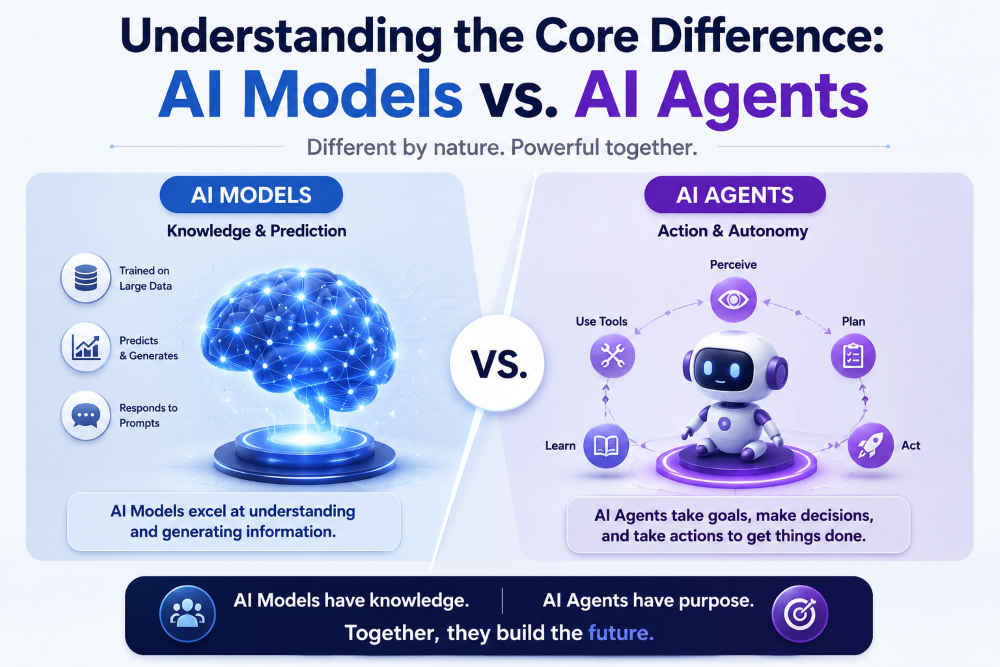
Artificial intelligence has experienced an exponential rise in interest, bringing terms like "AI models" and "AI agents" into everyday tech conversations. With cutting-edge Large Language Models (LLMs) such as OpenAI’s GPT, Google’s Gemini, and Anthropic’s Claude capturing headlines, many people naturally ask: If AI models are already so capable, why do we need AI agents at all?
To appreciate the necessity of AI agents, it is essential to look under the hood of an AI model. At its fundamental level, a model like Claude or GPT is essentially a massive file of parameters and weights. When you feed text into a model, that text is broken down into numerical tokens, which pass through billions of complex mathematical calculations. The model then processes these tokens and produces an output in the form of text .
While this mechanism allows for impressive text generation, problem-solving, and conversational capabilities, the model itself is entirely isolated. It simply receives input text and returns output text. Understanding this boundary is key to recognizing why software developers and engineers build AI agents to bridge the gap between abstract reasoning and real-world application.
The Limitations of a Pure AI Model
Despite their sophisticated ability to process language and emulate human reasoning, AI models on their own face significant functional constraints in production environments:
No Direct Action Capability: An AI model cannot open a web browser, execute a terminal command, or modify files on a hard drive by itself.
No Real-Time State Memory: Out of the box, a model does not natively remember interactions outside the context window provided to it.
Isolation from System Resources: A standalone model cannot interact with external APIs, databases, or local file systems without software wrapper instructions.
Text-In, Text-Out Constraint: The primary scope of a base model is strictly processing input text and producing response text.
The Analogy: The Brain vs. The Body
An intuitive way to understand the distinction between an AI model and an AI agent is through the human biological analogy of the brain and the body.
Think of the AI model as the human brain. The brain is capable of deep analysis, creative thinking, logical evaluation, and strategic planning . However, a brain operating in isolation cannot physically alter its surrounding environment. To interact with the physical world—to write on paper, walk to a destination, or fix a broken tool—the brain requires a body equipped with eyes, hands, and legs.
In this framework, the AI Agent acts as the body. It provides the surrounding software framework, interfaces, and tools that allow the AI "brain" to perform real actions, receive sensory feedback from system execution, and continuously adapt its steps toward completing a specific objective.
How AI Agents Work in Practice
AI agents work by embedding the model within an execution loop capable of calling system tools and acting upon external environments. Rather than answering a user prompt in a single turn, an agentic system operates through an iterative step-by-step workflow.
Consider the practical example of a software development scenario where an AI coding agent is tasked with diagnosing and fixing a bug in a codebase:
Initialization: The agent software receives a task description from the developer alongside a defined directory of accessible system tools (such as reading files, executing terminal commands, or writing code updates).
Tool Exposure: The agent presents the problem statement along with the tool options to the underlying AI model.
Decision Generation: The AI model evaluates the context and generates a structured tool call indicating which action should be taken next (e.g., read a specific source file or run a test suite).
Execution & Feedback Loop: The agent framework executes the requested command on the host environment, captures the command's stdout or error outputs, and passes those results back to the model.
Iterative Refinement: The model analyzes the updated error message or code state, deciding on subsequent operations—such as editing lines of code or re-running tests—repeating this multi-step process until the issue is fully resolved .
Throughout this process, the model itself never directly executes code or modifies a file on the host machine. Instead, the model acts as the decision engine, issuing instructions while the agent software handles execution, context management, and system safety .
Real-World Comparison: Claude Opus vs. Claude Code
A clear real-world demonstration of this concept can be seen in the distinction between foundational AI models and tailored agentic software:
The Foundational Model (e.g., Claude Opus): This is the underlying neural network responsible for advanced reasoning, language processing, and problem analysis.
The Agentic Software (e.g., Claude Code): This is the terminal-based coding agent wrapped around the model . It enables the system to interact with local repository files, issue command-line instructions, modify source code, inspect build output, and systematically resolve developer bugs.
Why AI Agents Are Key to Modern Automation
The progression from static AI models to autonomous AI agents represents a major step forward in enterprise automation and software engineering. While early AI implementations were limited to simple question-and-answer interactions, agentic frameworks unlock high-value workflows through autonomous execution:
Complex Multi-Step Task Resolution: Agents can plan, break down, and execute multi-stage objectives that require consecutive decisions over dozens of tool calls .
Self-Correction and Error Handling: When an operation fails, an agent captures the error log and prompts the model to generate alternative solutions dynamically.
Tool & API Integration: Agents bridge natural language commands to real system tools like Git version control, databases, continuous integration pipelines, and third-party web services.
Reduced Manual Overhead: By handling execution, monitoring, and validation internally, agents allow developers to delegate end-to-end task flows rather than manually supervising every input and output step.
By pairing the reasoning capability of advanced AI models with the execution infrastructure of software agents, organizations can build autonomous tools capable of handling complex engineering and administrative challenges end-to-end.